Most field service companies are looking for a solution that works, rather than building their own mobile stack. Whether it’s a waste collection company or a utility contractor, they usually prefer one supplier to provide the app, the hardware, and device management together. Buying hardware, choosing an MDM platform, and integrating everything into one system is work most customers would rather avoid.
For software vendors, this often opens the door to offering more than just the application. If you already sell a mobile application, you can offer customers the hardware and device management as part of the same solution. For many vendors, Android device management is what turns separate components into a complete solution. This article looks at how software vendors bundle a turnkey field service MDM into their product, using a deployment for a waste collection company in Eastern Europe as an example.
Why field service software vendors add device management
Installing a business app doesn’t automatically turn an Android tablet into a work device. Workers install personal apps. Devices gradually end up being used for much more than work. Before long, some employees are watching YouTube or playing games during working hours. When there is no device management in place, customers usually blame the software vendor when things start going wrong, even if the application is not the problem.
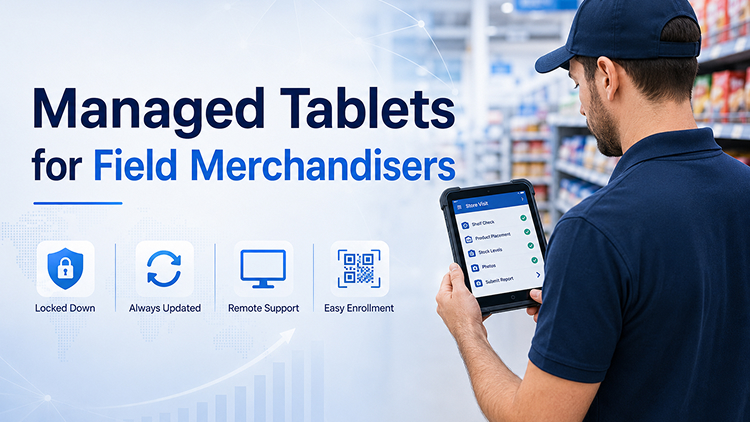
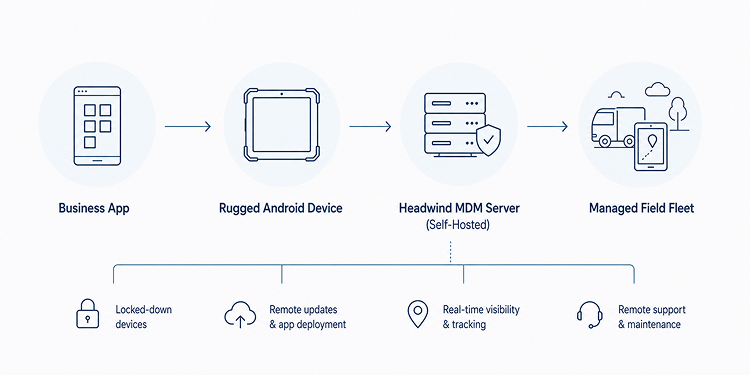
This is where device management makes a difference. It locks tablets to approved apps and lets IT push updates remotely instead of configuring every device by hand. IT teams can also see where devices are and monitor how they’re being used. For the vendor, it adds recurring service revenue and reduces reliance on one-time software sales.
How one deployment became a repeatable solution
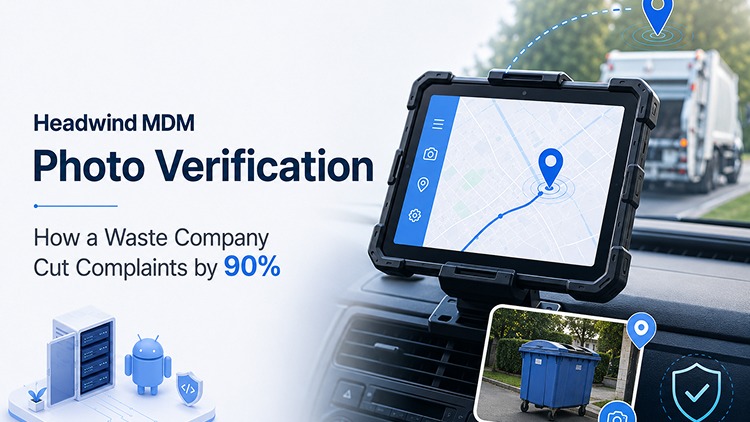
It all started with a single pilot project. A software vendor developing automation tools for field service companies combined its own application with rugged Android tablets and an MDM platform. The complete solution was first deployed at a mid-sized waste collection company.
Each service vehicle received a tablet, while IT managed the entire fleet from one console. Each device was configured for work only, so drivers couldn’t install other apps or use the tablet for personal purposes. Dispatchers could monitor device status in real time and verify that planned routes were being followed. As the deployment progressed, complaints about missed pickups began to decline.
The pilot quickly became a reference project for future customers. Other regional operators saw the results and wanted a similar deployment. What began as a single deployment soon became a standard offering. New customers received the software, the devices, and Headwind MDM as a single package.
Turnkey field service MDM: what the platform needs to support
A turnkey field service MDM designed for repeated deployments needs more from the platform than a single-tenant install. Some requirements become especially important.
Self-hosting
If you resell device management as part of your product, the console should run under your control or the client’s. A self-hosted deployment lets you run the server on your own infrastructure and keep client data there as well. It also means you are not tied to another SaaS vendor’s per-device pricing.
No Google dependency
Many field deployments use rugged devices without Google services or operate in environments where Google connectivity is limited. An MDM platform that supports AOSP devices running Android 9 or later, without requiring Firebase or Google accounts, works reliably on this type of hardware. It also works in air-gapped environments where cloud services can’t be used.
Kiosk and remote support
In most field deployments, tablets need to run only your application. Remote support reduces the time and cost of helping drivers who can’t resolve device issues on their own. Both help reduce the support workload for your team.
Enrollment without extra accounts
QR-code enrollment without requiring every device to be linked to Android Enterprise makes large deployments much easier. A field technician can provision a tablet on site without creating platform accounts first.
Why bundling MDM creates new revenue opportunities
Bundling MDM changes how your product generates revenue. Instead of selling only your software, you also generate revenue from device management. At the same time, customers are less likely to replace individual parts of the solution. When customers buy the application, hardware, and device management together, they have little reason to replace individual components.
In the waste collection deployment, the vendor bundled Headwind MDM Premium licenses with its own software and sold them as a single solution. Device management became a paid part of the service instead of an internal cost. To learn more about licensing, visit our pricing page or contact us about partner and reseller options.
Where Headwind MDM fits, and where competitors are strong
Cloud-first platforms like Scalefusion, Hexnode, and TinyMDM provide feature-rich dashboards designed to support a wide variety of device types and deployment scenarios. That flexibility often comes with more complex interfaces and onboarding workflows. For vendors who need to manage a mixed fleet across multiple operating systems, that breadth is real value, and for some resale models it is enough.
| Cloud-first platforms |
Headwind MDM | |
|---|---|---|
| Server hosting | Vendor’s cloud only | Self-hosted, on your infrastructure |
| Source code access | None on any plan | Mobile app source with commercial editions |
| Google services | Required for enrollment | Not required, works on AOSP 9+ |
| Air-gapped deployment | Not supported | Supported |
| Pricing model | Per-device SaaS subscription | Licensing under your control |
The picture changes once you start building your own product on top of the platform. Hosted-only tools keep the server, the data, and the roadmap outside your control. Headwind MDM approaches this differently. The Community Edition is open source under the Apache License. Commercial editions follow an open-core model. Paying customers also receive access to the mobile app source code, which most closed platforms do not provide on any plan. You self-host the server, you keep client data on your infrastructure, and your bundle does not depend on an outside vendor’s account system or pricing changes.
For a software vendor assembling a turnkey field service product, that control is usually worth more than a hosted dashboard.
How to test an MDM bundle before you sell it
If you sell software to field service companies and want to add device management to the package, the fastest path is to test the bundle yourself. Deploy Headwind MDM on your own server, enroll a rugged tablet with your app, and verify that kiosk mode and remote support work the way your customers expect.
Unlock new revenue by shipping a turnkey field service MDM with your mobile software. See licensing details or contact us about reseller options.
FAQ
Can I resell Headwind MDM as part of my own product?
Yes. Commercial editions can be bundled and resold with your software. Contact the team about partner and reseller options.
Does Headwind MDM work without Google services?
Yes. It runs on AOSP devices with Android 9 or later, with no Firebase or Google account requirement, which makes it suitable for rugged hardware and air-gapped sites.
Can I host the management server myself?
Yes. Self-hosted, on-premises deployment is the default, so client data stays on your infrastructure.