Scalefusion is a cloud-based UEM platform for managing different types of devices from one console. It supports Android, iOS, macOS, Windows, Linux, and ChromeOS. Pricing is public and based on the number of devices, and automated enrollment is available across supported platforms. For a company with a mixed fleet, the appeal is obvious: one system can cover most of the major operating systems its IT team is likely to encounter.
Headwind MDM is a different kind of product. It manages Android and AOSP rather than trying to support every major desktop and mobile OS. Companies can host it themselves, and the Community Edition is open source.
Scalefusion supports more operating systems, and there is no question about that. But many Android deployments do not need macOS, Windows, or iOS management in the first place. They may care more about where the MDM server runs, who controls the data, whether the source code is available, or whether devices can operate without Google services. That is where the comparison becomes more interesting.
Quick comparison
| Area | Headwind MDM | Scalefusion |
|---|---|---|
| Type | Open-core Android MDM | Proprietary UEM (cloud-hosted) |
| Open source | Yes (Community Edition, Apache License) | No |
| Platforms | Android / AOSP | Android, iOS, macOS, Windows, Linux, ChromeOS |
| Hosting | Self-hosted or cloud | Vendor cloud only (dashboard hosted by Scalefusion) |
| On-premise / air-gapped | Yes — self-hosted; supports isolated LAN and air-gapped deployments | No — cloud dashboard; On-Premise Connector only bridges to local AD/Exchange |
| AOSP / non-GMS support | Yes — no Google services required | Yes — agent-based management for non-GMS |
| Free production tier | Free Community Edition, unlimited devices | No — 14-day trial, 10-device minimum |
| Pricing model | One-time Premium license + optional support | Per-device subscription, billed annually |
| Paid pricing | Pay-once, tiered by fleet size | $2 Essential / $3.5 Growth / $5 Business / $6 Enterprise per device/month |
Pricing and total cost of ownership
Scalefusion publishes its pricing, which is more than many competitors do. Plans are billed annually at $2 per device/month (Essential), $3.5 (Growth), $5 (Business), and $6 (Enterprise), with a 10-device minimum and a 14-day trial. There is a catch for companies interested in its broader OS coverage: the $2 Essential plan covers only Android and iOS. To add Windows, macOS, Linux, and ChromeOS, you need the $5 Business plan. In other words, the full multi-OS story starts at a noticeably higher price.
The maths is straightforward: add more devices, and the bill goes up. The subscription also comes back every year. A company running 300 devices on the Business tier is looking at:
$5 × 300 × 12 = $18,000 per year. Keep that fleet for three years and the subscription reaches roughly $54,000.
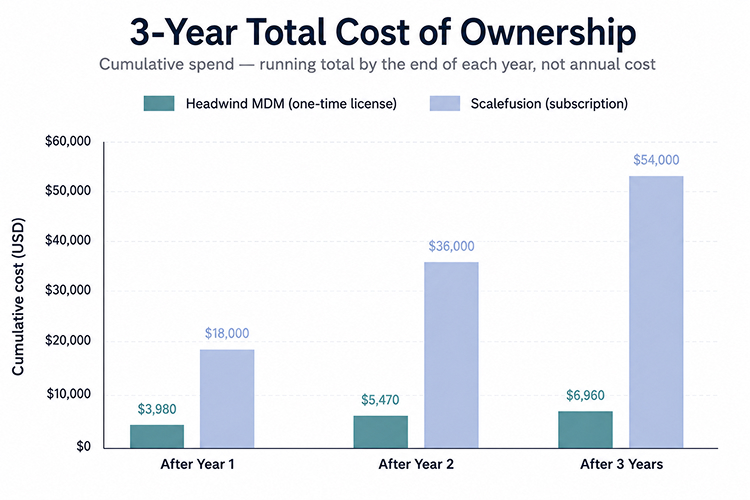
Headwind MDM does not use the same pricing model. The Community Edition is free with no device limit when self-hosted. The Premium license is purchased once and priced by fleet size, and it never expires. Annual support is technically optional, but most teams keep it active — it delivers updates and covers new devices as the fleet grows — and it renews at a fraction of the license cost.
Even with support kept current, the total stays several times below a per-device subscription over a multi-year horizon, as the chart above shows — and the gap widens the longer the fleet stays in service.
Self-hosting does come with extra work. Your team is responsible for the server, updates, certificates, backups, and uptime. With Scalefusion, the vendor takes care of that part. For a small IT team with no interest in maintaining another server, that may easily justify the higher recurring cost.
Hosting, data ownership, and air-gapped networks
Hosting is probably the biggest difference between the two platforms. Scalefusion is a cloud-hosted platform: the management dashboard runs on Scalefusion’s infrastructure, and device traffic passes through it. Scalefusion does offer an On-Premise Connector, but that isn’t a self-hosted server — it’s a secure bridge that lets the cloud dashboard reach resources inside your network, such as Microsoft Active Directory or Exchange. That becomes a problem when the network cannot connect to an external cloud at all. In that kind of environment, a cloud-hosted control plane is simply not an option.
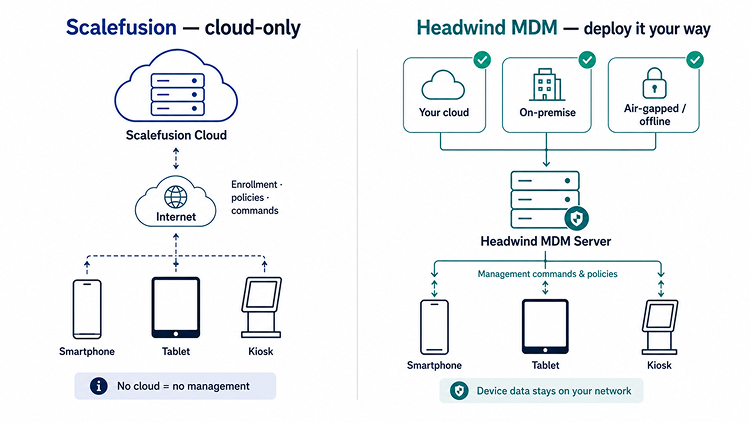
Headwind MDM is built to run on-premise from the ground up, including fully air-gapped networks. You install the server on hardware you control, and the database belongs to you alone — device records, location history, and configuration stay on your own infrastructure. Headwind MDM also has its own push mechanism and does not rely on Google Firebase Cloud Messaging. This matters on networks where Google services are unavailable or intentionally blocked. The MDM server can continue communicating with devices without bringing an external cloud service into the loop. For defense, critical infrastructure, and regulated environments where outbound connections are blocked by policy, a fully self-hosted architecture can be a fundamental requirement.
Open source vs closed source
Scalefusion is closed-source across all plans. You get the features the vendor ships and follow the roadmap they set.
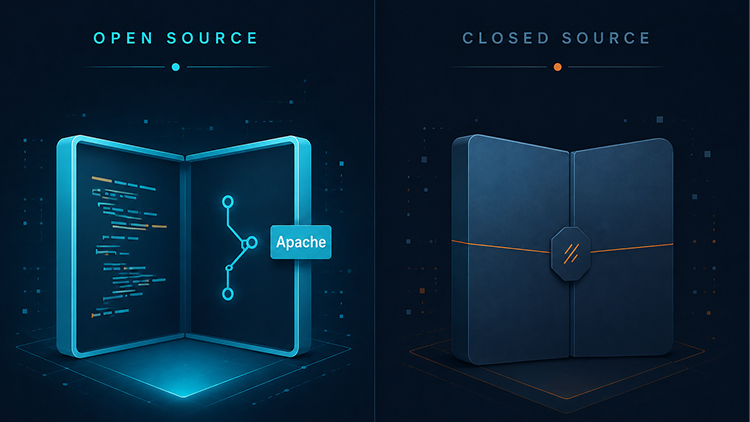
Headwind MDM follows an open-core model. The Community Edition — both server and Android agent — is published on GitHub under the Apache License. Your security team can read the code, audit how device data is processed, and verify the agent behaves as documented. For Enterprise customers, the mobile app source is provided directly, giving room for deep customization. If a source-code review is a precondition for deployment, you can hand over the actual source rather than a whitepaper. Open source also protects against single-vendor lock-in — the platform doesn’t disappear or change terms if the vendor pivots, because you hold a copy of the code you’re already running.
AOSP and enrollment without Google services
Scalefusion has invested in AOSP: it manages non-GMS devices through an agent-based approach rather than relying solely on Android Enterprise APIs, and it partners with rugged OEMs like Zebra and Bluebird. If your fleet mixes GMS and non-GMS Android, Scalefusion can handle it.
AOSP and non-GMS devices are much closer to Headwind MDM’s core use case. It requires no Google services at all — enrollment happens by QR code, direct download, or a pre-installed image, none of which contact Google. It supports AOSP builds, custom ROMs, and OEM hardware that may ship without Google Mobile Services or the Play Store. For manufacturers, the open agent can be integrated at the system level and baked directly into firmware, giving OEMs greater visibility and customization freedom than a closed-source agent typically provides. So both products can manage non-GMS Android devices.
Android specialist vs multi-OS UEM
Scalefusion manages Android, iOS, macOS, Windows, Linux, and ChromeOS — plus mass-enrollment programs like Apple Business Manager, Windows Autopilot, Android Zero-Touch, and Samsung KME — from one console. If your fleet contains iPhones, Windows laptops, and Android tablets, that single-console coverage is a real advantage an Android-only tool can’t provide.
Headwind MDM takes the narrower route and focuses only on Android and AOSP. That specialization shows up most clearly in dedicated-device scenarios: kiosk mode, a managed launcher, silent application deployment and updates, custom application configuration, device location, remote control, web traffic filtering, non-GMS deployments, and direct agent preinstallation into OEM firmware. Organizations aren’t paying to support operating systems they don’t run. In practice, the right choice depends on the devices you actually manage.
Which platform fits your fleet?
For a company managing Windows laptops, Macs, iPhones, and Android devices together, Scalefusion is the more obvious fit. Its broader OS coverage and cloud delivery remove the need to run separate management systems or maintain your own MDM server.
Headwind MDM is the stronger choice when control and independence are the priority: an Android or AOSP fleet, data-residency rules or a security audit that require code and data on infrastructure you own, air-gapped networks with no external dependency, or a one-time license that beats a subscription renewing forever — especially past a few hundred devices. A practical way to compare the two is to test them with your own devices. Headwind MDM’s Community Edition can be self-hosted for free, while a cloud trial is also available.
FAQ
Is Headwind MDM a true open-source alternative to Scalefusion?
For Android and AOSP, yes. Headwind’s core — server and agent — is open source under the Apache License and runs on your own infrastructure. Scalefusion is a closed-source UEM. The trade-off is coverage: Scalefusion also manages iOS, Windows, macOS, Linux, and ChromeOS, while Headwind focuses on Android.
Can Scalefusion run on-premise or air-gapped like Headwind MDM?
Not in the same sense. Scalefusion’s dashboard is cloud-hosted; its On-Premise Connector only bridges the cloud to local resources like Active Directory or Exchange, not a self-hosted server. Headwind MDM installs on your own infrastructure and runs fully air-gapped, with no external activation and no reduced feature set inside a closed network.
How does Headwind MDM pricing compare to Scalefusion?
Scalefusion uses per-device subscription pricing billed annually ($2–$6 per device/month across tiers, 10-device minimum), with multi-OS coverage starting at the $5 Business tier. Headwind MDM offers a free Community Edition for unlimited self-hosted devices and a one-time Premium license tiered by fleet size — typically several times cheaper over a multi-year deployment.