Most MDM reseller relationships do not begin with a formal partner strategy. They begin when an existing customer asks a practical question: “Can you configure these 80 Android tablets without setting up every device by hand?”
For an IT provider, that request can become more than a one-time software sale. The customer may also need installation, device enrollment, policy configuration, staff training, application updates, and local support. Those services are what make an MDM reseller business commercially attractive.
This guide turns the idea into a practical MDM reseller business plan. It covers customer selection, service models, licensing costs, margins, supplier requirements, and the sales process, with a focus on company-owned Android devices.
Market figures are useful mainly as directional indicators. Grand View Research valued the global mobile device management market at $7.67 billion in 2024 and projects that it will reach $28.37 billion by 2030.
A small reseller does not need a measurable share of the global market. It needs a handful of local companies with the same operational problem: too many Android devices to configure manually and too little internal expertise to manage them properly. Retail, logistics, field service, manufacturing, healthcare, and public-sector organizations all encounter this problem, although their purchasing processes can be very different.
Who buys MDM from a reseller?
Offline and field businesses
Retailers, wholesalers, delivery companies, transport operators, and field-service teams often configure Android devices manually. This works with five tablets, but it doesn’t scale well once the fleet reaches 50 or more devices.
These companies are usually the best starting point for a new reseller. Their requirements are easy to demonstrate on a real device by installing the required applications, blocking unwanted settings, enabling kiosk mode, and showing the device in the management console.
Look for a company with 25–300 Android devices, a clearly identified IT decision-maker, and the same configuration repeated across the fleet. The reseller can charge for deployment, training, and local support as well as the software license.
Technology companies and Android product builders
Some customers use Android as part of their own product. Examples include payment terminals, digital signage, vehicle displays, medical equipment, and industrial controllers.
These projects may require source code, API integration, a custom launcher, platform-key signing, or changes to the Android application. Before preparing a proposal, confirm whether the hardware runs standard Android with Google Mobile Services or a custom AOSP build.
If your team does not have Android engineers, involve the MDM vendor in the first technical discussion. A complex product integration is a risky first project for a sales-focused reseller.
Government Agencies
Government customers often request an on-premises deployment, local data storage, audit records, and operation inside a private or air-gapped network. The technical requirements may be familiar, but procurement can involve tenders, security reviews, certifications, and several levels of approval.
This market works best for resellers that already understand public-sector procurement. Without existing references, a smaller field-service deployment is usually a safer first deal.
Headwind MDM describes these customer groups and the available commercial arrangements on the reseller options page.
Choose the MDM reseller model before setting your prices
Two companies may both call themselves MDM resellers while running completely different businesses. One earns a commission for referring a customer to the software vendor. The other hosts the platform, provides support, and sends a monthly invoice for every managed device.
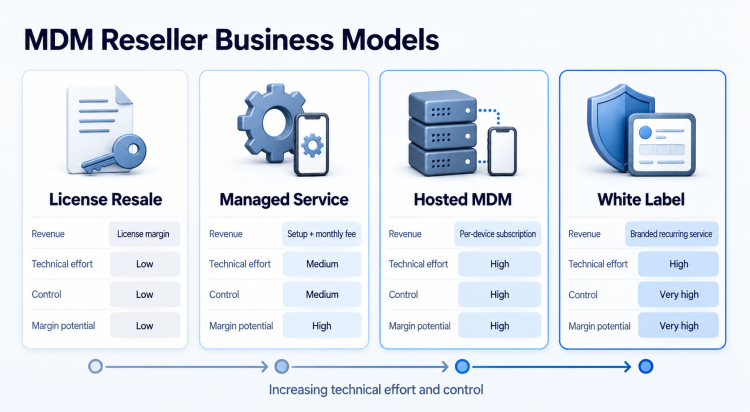
License resale
This is the simplest way to enter the market. You find the customer, demonstrate the software, help close the deal, and earn a discount or commission on the license.
License resale requires little infrastructure and works well when MDM is included in a larger hardware or IT project. On its own, however, the offer is difficult to differentiate. The customer can see the public software price and may ask why the license should be purchased through you.
MDM as a managed service
A managed service combines the software with work the customer does not want to handle internally. This may include device enrollment, policy configuration, application updates, monitoring, reporting, and first-line support.
The customer normally pays an initial deployment fee and a monthly service charge. Even when the underlying MDM license is perpetual, the service around it produces recurring revenue.
Hosted MDM service
A reseller can also operate the MDM server and sell access to several customers. This gives the reseller more control over pricing and service packaging.
Before choosing this model, check that the software license permits commercial hosting. The platform must keep customer accounts, administrators, policies, and device data separate.
Headwind MDM supports multi-tenancy for SaaS resale through an Enterprise license. Enterprise pricing is quoted individually based on the project requirements.
White-label MDM
A white-label service is sold under the reseller’s own name and visual identity. This can strengthen the customer relationship because the reseller is presenting a complete service rather than another company’s software.
The scope of rebranding must be agreed in advance. Changing the logo and copyright in the web console is not the same as delivering an Android application with a new package name and signing key.
What must be ready before the first customer
You do not need a large team to become an MDM reseller. During the first few projects, one person can handle sales and customer communication while another prepares demonstrations and deployments.
The technical requirements depend on what you plan to sell. A license reseller needs product knowledge and a reliable demonstration. A company offering managed hosting also needs experience with Linux administration, DNS, TLS certificates, backups, access control, and Android enrollment. Custom AOSP projects require an Android developer, not just a general IT administrator.
The MDM guide for IT technicians covers many of the questions that arise during a technical evaluation.
Decide who operates the infrastructure
Before quoting a self-hosted deployment, decide who will control the domain, server account, backups, administrator credentials, and software updates. The contract should also explain how customer data and devices will be handed over if the service ends.
Some regulated customers need the MDM server to run inside their own network. Do not promise this based only on a feature list. Test the required device functions and review the limitations described in the guide to MDM for private networks.
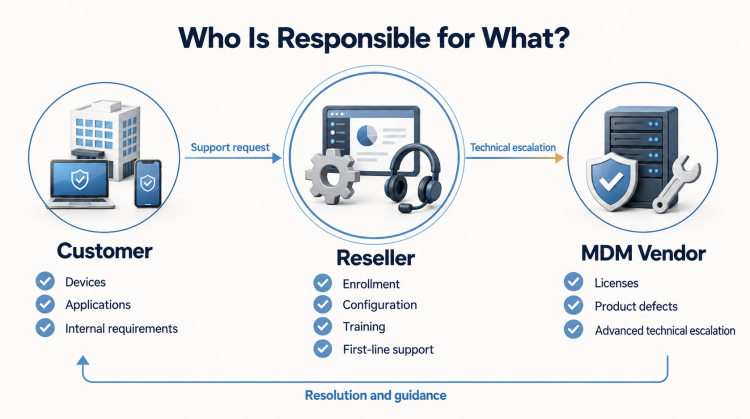
Agree on the support scope
The customer needs to know whom to contact first. In most reseller projects, the local partner handles enrollment, device checks, and user questions. Product defects and complex server issues are escalated to the software vendor.
Calculate the deal before sending a quote
A license deal can look profitable until the reseller adds two customer visits, a day of configuration work, and several months of support. To avoid this, calculate three parts of the deal separately:
- margin on the software license;
- profit from deployment and training;
- monthly contribution from hosting and support.
Headwind MDM publishes the figures needed for the license calculation. As of August 2026, a perpetual Premium license for up to 300 devices costs $2,990 and includes one year of premium support. Optional support renewal costs $1,490 per year.
The published reseller discount is 30% on the first Premium license and 50% on subsequent Premium licenses.
For the first license, the calculation is:
- customer license price: $2,990;
- reseller cost after the 30% discount: $2,093;
- gross license profit: $897.
At the same public price, a subsequent license purchased with the 50% discount would cost the reseller $1,495, leaving $1,495 in gross license profit.
This is not net profit. Payment-processing fees, local taxes, exchange-rate changes, customer discounts, and sales time still need to be deducted.
Example: a managed service for 100 devices
Assume that the reseller sells the first Premium license, charges $900 for deployment and training, and provides ongoing management at $3.50 per device per month.
Deployment requires 12 hours of work at an internal cost of $25 per hour. Hosting and support cost the reseller an average of $1.25 per device per month. These service prices are planning assumptions, not Headwind MDM’s recommended rates.
The first-year calculation would look like this:
| Item | Revenue | Direct cost | Gross profit |
|---|---|---|---|
| Premium license | $2,990 | $2,093 | $897 |
| Deployment and training | $900 | $300 | $600 |
| Managed service for 12 months | $4,200 | $1,500 | $2,700 |
| Total | $8,090 | $3,893 | $4,197 |
For this 100-device customer, first-year revenue is $80.90 per device. The managed-service portion generates $42 in annual revenue and $27 in annual gross profit per device.
The complete deal produces a gross margin of 51.9% before customer-acquisition costs, overhead, and taxes.
If acquiring the customer costs $1,000, the combined license and deployment profit covers that cost when the project begins. Measured only against the monthly service contribution of $225, the payback period is approximately 4.4 months.
Current license and support terms are available on the pricing page.
Choose a supplier that leaves room for your service
The software supplier affects more than the feature list. Its licensing rules determine how much margin you can keep, where the platform can run, and whether you can host or rebrand the service.
Review the difference between open-source and proprietary MDM before making a decision. Source-code access may be important for an Android product company, while a small MSP may care more about simple deployment and predictable support.
Will the platform work with the customer’s devices?
Test the Android versions, device manufacturers, enrollment methods, kiosk requirements, and applications used by your target customers. If you plan to work with AOSP hardware, confirm that the essential functions do not depend on Google Mobile Services.
Do not rely only on a compatibility list. Test at least one of the device models you expect to manage.
What will the license allow you to sell?
Check whether the software is licensed per device, per server, per customer, or by subscription. Ask about minimum orders, device limits, annual support, commercial hosting, and multi-tenancy.
A license that works for a direct customer may not automatically permit the reseller to host the platform and charge other companies for access.
How is the reseller margin calculated?
Request the discount or commission in writing. Confirm whether it changes for the first deal, later licenses, renewals, registered opportunities, or different regions.
Also establish who owns the customer relationship. The agreement should explain whether the supplier can approach a registered customer directly and what happens to the account if the partnership ends.
Where can the platform run?
Confirm whether the MDM system can operate in the vendor’s cloud, on the reseller’s server, on the customer’s premises, or inside a private network. If an air-gapped deployment is required, test it before including it in the proposal.
What support will the reseller receive?
Ask for the support hours, available languages, expected response times, escalation route, and access to technical training. Clarify which issues the reseller should handle and which ones can be passed to the vendor.
Finally, check the exit process. Customer data export, license continuity, device migration, and service handover should be understood before the first contract is signed.
A practical MDM reseller sales playbook
Find customers through their Android device projects
Most potential customers will not describe themselves as MDM buyers. They will be opening new retail locations, deploying a driver application, ordering rugged scanners, installing kiosks, or developing an Android-based product.
These projects create the need for device management, even when the company has not started searching for an MDM platform.
Begin with organizations that already know your company. An existing hardware or IT-services customer is usually easier to approach than a completely cold account. You already understand its infrastructure, purchasing process, and technical contacts.
Start the conversation with the workflow
A message about “advanced endpoint management” is easy to ignore. A question about a current device problem is more likely to receive an answer.
For example:
How are the new Android handhelds being configured, updated, and supported after they are issued to employees?
The response can reveal whether devices are still being prepared manually, whether application versions are inconsistent, and how much time the IT team spends supporting the fleet.
Demonstrate the customer’s use case
Ask for the device model and one application that must be deployed. During the demonstration, enroll the device, install the application, apply kiosk restrictions, and change a policy remotely.
Give the pilot a defined finish line
Before starting a pilot, agree on the device count, required applications, participants, success criteria, and decision date.
Separate the items in the proposal
Show the software license, deployment, integration, training, travel, hosting, and recurring support as separate price lines.
A retail, logistics, or field-service project may close within a few weeks after a successful demonstration. Government, regulated-industry, and custom-integration projects usually require a longer sales cycle.
How to answer common customer objections
“Our device data cannot leave the company network”
Explain how an on-premises deployment would work and who would be responsible for the server, backups, software updates, and administrator access. The customer should understand that self-hosting provides infrastructure control but also creates operational responsibilities. If the network is isolated from the internet, test the required device functions before preparing the final proposal.
“The price is too high”
Do not compare only the first invoice. Calculate the cost over three years, including the license, support renewal, hosting, internal setup time, device downtime, and the work required to replace the platform later. The discussion should focus on the cost of operating the device fleet, not only on the price of the MDM software.
Common reasons new MDM resellers fail
- Competing only on license price. The sustainable margin is usually in configuration, hosting, training, integration, and support.
- Ignoring license and exit terms. Verify hosting rights, data export, customer ownership, renewal, and service continuity after the partnership ends.
- Running an open-ended free pilot. Set scope, success criteria, responsibilities, and a decision date.
A 30-day launch plan for an MDM reseller business
- Choose one vertical and one device workflow.
- Interview five existing or target customers about fleet size, setup, support, and purchasing.
- Compare three vendors with the checklist above and obtain commercial terms in writing.
- Build one repeatable demonstration on a real Android device.
- Define software, deployment, and monthly support as separate price lines.
- Document enrollment, backup, updates, and support escalation.
- Approach 30 carefully selected prospects and offer a scoped demonstration, not a generic product pitch.
The right supplier depends on the market you plan to serve. Multi-OS MSPs may prioritize a broad cloud UEM and partner portal. Android specialists may place more value on self-hosting, private-network operation, source access, transparent margin, and rebranding. Headwind MDM is one option for the second profile: it offers a free Community edition for evaluation, perpetual Premium licensing, published Premium reseller discounts, and an Enterprise option for multi-tenant or source-level projects.
Evaluate an Android MDM reseller partnership
Review the current Headwind MDM reseller options, then contact the team to discuss your target market, deployment model, and first customer use case.