Al Shukaili Trading manages the Android POS terminals at its fuel stations across the country with Headwind MDM. The terminals process fuel card payments. Every unit must run the same approved software and security settings.
Before Headwind MDM: Every POS Update Required a Site Visit
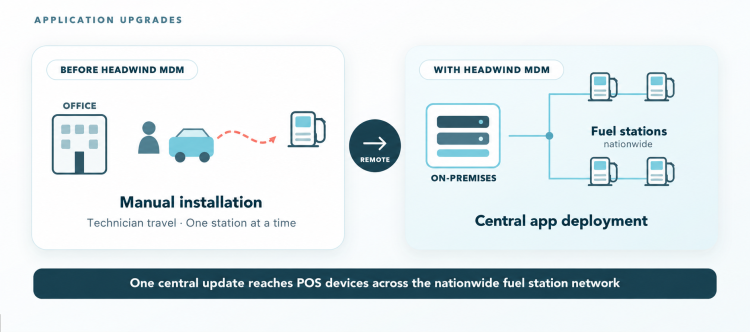
Previously, every app update or configuration change required a technician to visit the station. Attendants could not install software or change settings on payment devices. The company had to control the software on every terminal directly.
With stations spread across the country, even a minor update meant a separate trip to every station.
Why Al Shukaili Trading Chose Headwind MDM: Open-Source Client and On-Premise Server
Pricing and standard MDM features weren’t the deciding factors for Al Shukaili Trading. There were two architectural requirements:
- Open-source Android client. The POS terminals run specialized fuel retail software on nonstandard hardware. The team had to be able to modify the MDM client to fit that environment. Closed-source MDM platforms do not allow this.
- On-premise server. The company’s security requirements for fuel card payments ruled out cloud-hosted MDM. This requirement alone eliminated most of the market. Many MDM vendors have moved to cloud-only models in recent years.
Headwind MDM met both requirements. As an extra option, the system provided centralized remote management.
How Headwind MDM Changed POS App Upgrades
The fuel retail app on the terminals receives regular updates with new features and fixes. Each update required a technician to be present at a station during the upgrade procedure.
Now the team prepares each update centrally and pushes it to all terminals from the MDM server. Deployment needs no site visit.
Four Years In
Al Shukaili Trading has run Headwind MDM for more than four years. The company has not measured the hours or site visits saved. The team reports a sharp drop in technician travel for routine app updates and configuration changes. It calls this one of the biggest benefits of managing a distributed fleet centrally.
Advice for Others: Look Past the Feature List
Al Shukaili Trading advises companies with distributed POS or retail fleets to evaluate architecture before features. Start with two questions: can the platform be self-hosted, and can its client be adapted to nonstandard hardware? For Al Shukaili Trading, these questions narrowed the field faster than any feature checklist.
Running a POS or retail device fleet with strict security requirements? Contact our team for expert advice on self-hosted Android MDM.