Groupe MTA provides ticketing and access control services for large public events. The company manages a fleet of over 200 identical Android devices, running an in-house app in kiosk mode, shared among event staff. The deployments are short-term by nature. Devices spend far more time sitting in warehouse storage between events than they do in active use.
Before Headwind: When Play Store Friction Cost Uptime
Groupe MTA didn’t start with Headwind. The company first built its own front-end on top of Google’s Android Management API. It worked, but the platform’s Play Store-centric model created friction with Groupe MTA’s internal-only apps. That friction eventually cost the company uptime during a live event. The incident sent the team looking for a purpose-built MDM instead of a workaround layered on top of Google’s tooling.
Why Headwind: Pricing Got Their Attention, Self-Hosting Sealed It
Pricing put Headwind on the shortlist in the first place. With devices spending more time at rest in a warehouse than deployed in the field, a per-device-per-month model didn’t make sense. A flat-fee license did.
Pricing wasn’t the deciding factor on its own. Self-hosted deployment tipped the scale. Groupe MTA prefers to keep its infrastructure under its own control, and running Headwind on-premise meant it didn’t have to hand that control to a third party.
“Headwind MDM brings together the reliability of a managed solution and the freedom of self-hosting. We keep full control of our data and infrastructure while leaving the rest to the experts.”
Gabriel Arsenault, IT Technician, Groupe MTA
The Event Cycle: Provision, Deploy, Store, Repeat
Groupe MTA’s device fleet flexes with each event. Anywhere from a handful of devices to the full 200+ gets pulled for a given deployment. Before an event, devices are powered on, tested, updated, then powered off and packed into transport cases. Between events, they sit powered off in charging cradles in the warehouse.
The core requirement was simple: get a factory-reset device to a fully configured one, as automatically as possible. Headwind handles that end to end. Being able to swap configurations remotely, by group, turned out to be a valuable bonus on top of that. It helps when the same physical fleet needs to serve different roles across different events.
The Numbers: 5 Minutes Per Device to 16 at Once
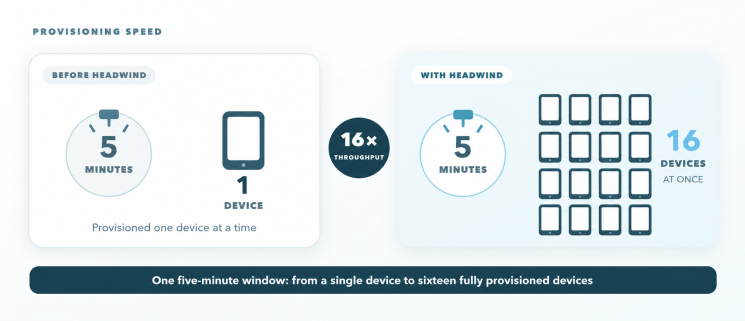
The clearest measure of impact is provisioning speed. What used to take about 5 minutes per device now lets the team provision 16 devices in that same 5-minute window.
Devices aren’t factory reset after every single use, since there’s no persistent data on them to clear. The real value shows up during live events. Field technicians can:
- factory reset a problematic device on the spot;
- temporarily unlock a device for quick diagnostics;
- reprovision it on the fly into a technician configuration with access to tools like WiFiman that regular operators don’t have.
Groupe MTA runs around a dozen events per year, plus a growing number of devices permanently deployed at fixed venues. Together that adds up to roughly 500 device check-outs annually.