A hardware deal usually ends once the devices are delivered. You make your margin on that order, but when the customer needs more tablets, you may have to compete for the business all over again. MDM gives you a reason to stay involved after the hardware has been handed over. You keep managing the devices, solving problems, and adding new units as the customer’s fleet expands. That ongoing relationship is the core of an MDM reseller business.
For many IT resellers, integrators, and MSPs, this is a fairly natural service to add. You already know how the client works, which devices they use, and where the usual problems appear. Instead of ending the relationship after delivery, you can continue with setup, updates, support, and day-to-day device management. Below is a practical look at how to build that service and why a self-hosted, open-source platform makes an MDM reseller business easier to run.
Why an MDM reseller business fits an IT or MSP portfolio
Many companies use Android tablets, rugged scanners, or kiosks without having anyone responsible for managing the whole fleet. The first ten devices are often set up manually. Later, someone has to repeat the same work for updates, replacements, and every device that stops behaving as expected. That is usually the point where outside help starts to make sense.
The customer is not really buying another piece of software from you. They are paying to keep the devices usable, consistent, and easier to support without touching each one individually. Once you know their apps, restrictions, and deployment process, replacing you becomes more difficult than switching hardware suppliers. Another supplier may quote a lower tablet price, but they will still need time to understand how the customer’s fleet is actually set up.
Why recurring revenue matters
The recurring revenue is what makes the model interesting for a reseller. The margin on one device may be larger, but it is earned only once. A management fee is smaller, yet it keeps coming in while the device remains in service.
Across the MDM market, managed device services are commonly priced in the range of a few dollars per device per month for standard plans, rising for enterprise features such as advanced security and compliance. Pricing will depend on how much support, hosting, and configuration you include. The useful part is that revenue grows with the number of devices under management. Ten customers with one hundred devices each already give you a fleet of one thousand devices to manage every month.
Which customers should you approach first?
Not every company with Android devices is equally easy to sell to, especially when you are just starting. Headwind MDM customers generally fall into three groups, each with a different sales process.
Traditional businesses that use Android devices are usually the best customer segment to start with. These are retail and wholesale companies, transport and delivery operators, and field-service firms that equip staff with Android tablets. Many of these companies still configure devices manually and may not know that MDM could solve the problems they face. A local reseller can demonstrate the software, adapt it to the customer’s workflow, and provide training in the customer’s language. They do not require source code, and they typically buy a Premium license tied to a single domain.
Tech startups are a harder first sale. These companies embed Android tablets into their own products and want deep integration, custom builds, and platform signing. These discussions often become technical very quickly. If such a customer contacts you early on, it may be better to involve the vendor rather than manage a complex engineering discussion alone.
Government organizations can be a strong customer segment if you already know how to sell to them. Their technical needs are similar to those of traditional businesses, but procurement is slow and bureaucratic. A reseller who already understands local public procurement procedures will usually have an advantage over an overseas vendor. For a new reseller, traditional businesses usually offer the shortest path from a product demonstration to a signed agreement.
Why an open-source, self-hosted MDM is easier to resell
Not every MDM platform is built for resellers. Several Headwind MDM features give resellers more flexibility than they would have with a closed, cloud-only platform.
Self-hosted, no cloud required. The server runs on your infrastructure or the client’s one, including isolated LAN or VPN networks with no internet access. This makes the platform suitable for government, industrial, and security-sensitive environments where an external cloud may not be allowed.
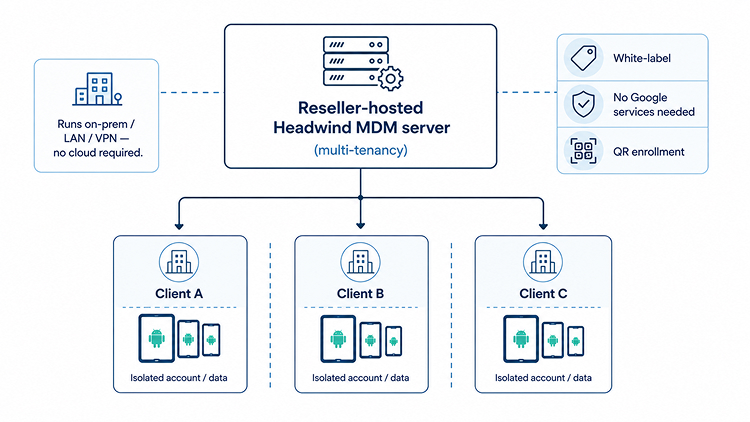
No hard dependency on Google services. Devices are enrolled by scanning a QR code. The platform supports hardware without Google Mobile Services, including custom Android builds. This makes it possible to work with devices that do not include licensed Google services.
White-label and rebranding. You can put your own name, logo, and copyright on the system, so the client sees your brand rather than the vendor’s. Premium customers can request this rebranding without paying an extra fee.
You can also run the platform on your own server and sell access as a monthly service. This is often more convenient for smaller customers that do not want to maintain a separate MDM server. With multi-tenancy enabled, several customers can use the same installation while keeping their accounts separate. Under an Enterprise license, there is no additional fee for each tenant.
The practical steps to get started
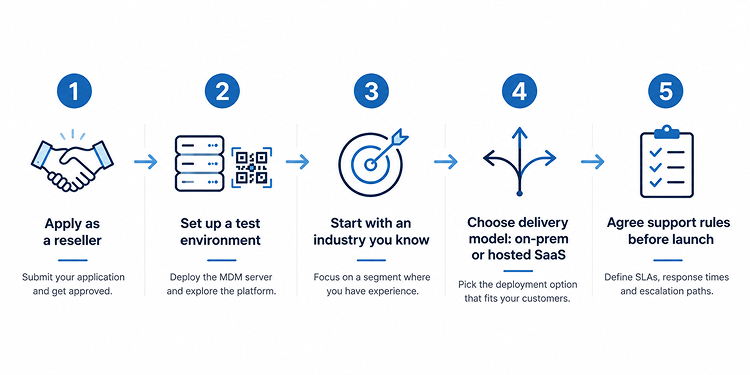
- Contact Headwind MDM and apply to become a reseller. New partners can currently purchase two Premium licenses for the price of one. This gives you some room to close the first projects without taking on the full licensing cost immediately. Before sending a commercial offer, check the reseller page for the latest discounts and revenue-sharing conditions.
- Set up a small test environment. Install the server and connect two or three Android devices. Try the things a customer is likely to ask about: QR enrollment, kiosk mode, app installation, restrictions, and remote updates. During a sales meeting, it is much better to show changes being applied to a real device than to explain everything with slides.
- Start with an industry you already know. Look through your existing customers and identify those using Android tablets, scanners, or kiosks. A delivery company, retailer, warehouse, or field-service team is usually easier to approach because the devices are already part of its daily work.
- Choose how the customer will use the system. Some companies will want Headwind MDM installed on their own server. Others will prefer to pay you a monthly fee while you host and maintain it. Decide which option you are offering before discussing price, because the workload and support requirements are different. You can also rebrand the interface if the service is being sold under your company name.
- Agree on support rules before launch. Give the customer a clear contact channel and explain what is included in the service. You should also know which issues your team will solve directly and which ones need to be passed to Headwind MDM.
Who should support the customer after launch?
Support can quickly consume the margin from a small deployment if every question has to be passed to the vendor. Headwind MDM can help with difficult technical problems, but its support is provided in English. The vendor does not know the customer’s local setup as well as you do and cannot physically inspect the device. Sending every minor issue upstream will usually make the response slower.
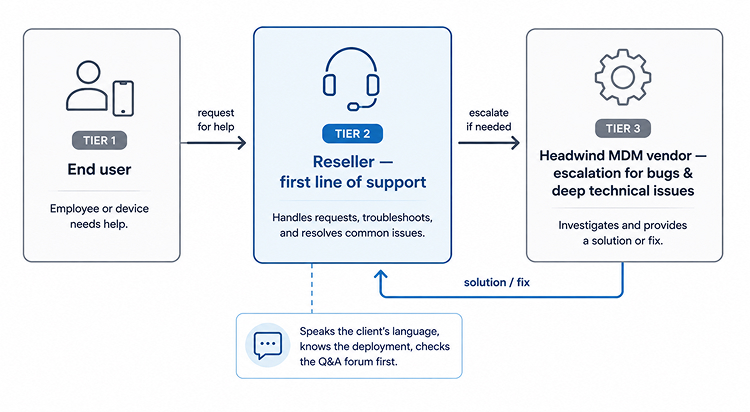
For that reason, customers should contact the reseller first. You know which apps are installed, how the devices were configured, and what the employees are supposed to see on the screen. You can also communicate in the customer’s language. Many common questions have already been answered in the public Headwind MDM forum, so it is worth checking there before opening a support request. The vendor should remain the escalation point for bugs and other issues that require deeper technical investigation.
Three mistakes that make the first deal harder
- Choosing a project that is too technical. A startup asking for firmware changes, platform signing, or source-code integration may need weeks of engineering discussions before a decision is made. Bring the vendor into such a conversation early, or leave this type of project until you have more experience.
- Quoting only the license. If the customer sees nothing except a software price, another reseller can simply offer a discount. Installation, device setup, training, hosting, and ongoing support are the parts of the offer that make your service harder to replace.
- Promising support that you cannot consistently provide. A small team should not advertise round-the-clock assistance unless someone is actually available. It is better to give the customer a realistic response time and meet it every time.
Where to find the first opportunity
Your first MDM customer may already be buying hardware or IT services from you. Look for a company whose employees use Android tablets, scanners, or kiosks and ask how those devices are currently configured and updated. Manual setup, inconsistent app versions, and frequent device returns are clear signs that an MDM service could help.
You do not need to launch a completely separate business. Start with one existing customer, solve one real device-management problem, and use that deployment as a reference for the next one. Current reseller terms and pricing are available from Headwind MDM, and the team can also arrange a product demo for potential partners.