A software company builds custom Android apps for public-sector and non-profit clients. Their data has to stay in the country, so a hosted MDM was not an option. The company runs Headwind MDM on its own server and manages close to 500 devices with it. Most apps install silently, and the team fixes issues directly in the source code.
Company Background and Android Fleet Size
The company builds and supports software in the Czech Republic. Part of its work is custom Android applications deployed to client organizations. Many of these clients are public-sector bodies and non-profits.
The internal IT team manages 450 to 500 Android devices. All of them run on a self-hosted Headwind MDM server.
Why Data Residency Ruled Out a Hosted MDM Service
Many of the company’s clients are public-sector bodies and non-profits. They handle sensitive personal data and require it to stay in the Czech Republic. For the company itself, in-country hosting is a preference. For its clients, it is effectively a requirement.
A hosted MDM would have added a new party to the data chain. The team would have had to answer questions about data processors and sub-processors. Storage location and retention would need documenting too. Each client would then have to add the MDM vendor to its own processing records.
“Self-hosting removes those questions,” the company’s IT team explains. “The MDM database sits on our own server in the Czech Republic.”
Read more about Headwind MDM security.
Contributing Fixes to the Headwind MDM Source Code
The team has contributed to the upstream Headwind MDM repositories. Its contributions include Czech translations and small bug fixes. The team has also added some new functionality.
The process is straightforward. When a feature does not behave as needed, an engineer reads the code and patches it locally. The server keeps running on the patched version. The fix then goes upstream so every Headwind MDM user gets it.
With a closed-source vendor, the same issue would become a support ticket. The fix would then wait for a slot on someone else’s roadmap. Learn more about open source Headwind MDM.
Silent Installation of In-House Android Apps
About 90% of the apps the company deploys are its own APKs. They are hosted in the company’s own repository. Headwind MDM installs them on devices silently, with no one needed on site.
This covers the bulk of the fleet’s software. The team pushes new builds from its repository, and devices pick them up automatically.
The Google Play Limitation in Self-Hosted Android MDM
The remaining 10% are apps that customers need from Google Play. These need a person at the device. Someone signs in with a Google account and installs the app from Play. If the customer’s policy requires it, the account is removed afterward.
Once an app is installed, Play updates it automatically. Adding another Play app takes a single tap on Install. If the account was removed, though, the sign-in step has to be repeated.
“It works well enough in practice, since it only affects a small share of our apps,” the team says. “But it is the part of the workflow we would most like to see improved.”
Headwind MDM itself does not need a Google account to enroll or manage devices. The account is only required by the Play Store.
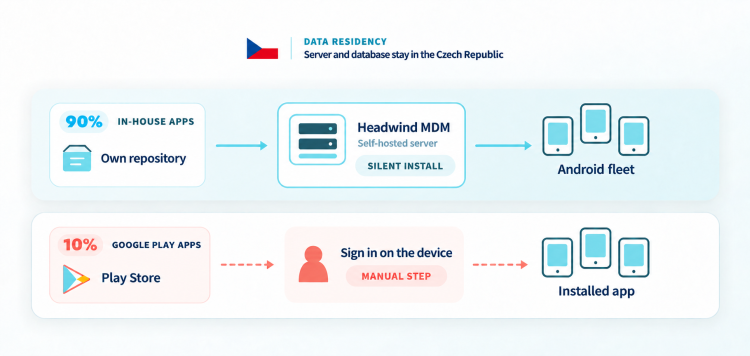
Two paths to the same Android fleet
Key Takeaways for Teams Choosing an Android MDM
- If client data must stay in one country, a self-hosted MDM keeps a new vendor out of the processing chain.
- Source code access lets a small team fix issues on its own schedule.
- Hosting your own APKs gives you fully silent deployment across the fleet.
- Plan hands-on time for any apps that must come from Google Play.
Want to run your MDM on your own infrastructure? Download Headwind MDM open source or compare Premium plans.