Rugged tablets are built to withstand conditions that would quickly destroy ordinary hardware. Drops onto concrete, dust, engine heat, the shaking of a truck bed. That is why field crews buy them.
But buying the tablets is the easy part. Once you hand fifty of them to workers spread across a couple hundred kilometers, the real trouble starts with the software. Unauthorized apps get installed. Updates sit for weeks without being applied. And when a device goes down, nobody back at headquarters can reach it.
A cement and concrete manufacturer ran into all of this. MDM for rugged devices fixed it. Here is what deploying Headwind changed.
The Challenge: 50 Tablets Across Remote Sites in Africa
The company carried out field safety inspections at industrial sites scattered across remote parts of Africa. Fifty inspectors carried rugged tablets to log their checks and stay connected where cellular coverage was limited.
The tablets themselves worked fine. The way they were managed did not. A few problems kept coming back.
The data bills climbed month after month. Nothing stopped inspectors from browsing the web or installing whatever they liked, so a good chunk of the mobile data had nothing to do with inspections.
The inspection app often became outdated. New versions came out of headquarters, but pushing them to every device was slow and manual. Some inspectors kept working on old builds, which became a problem the moment an audit asked which version logged a given check.
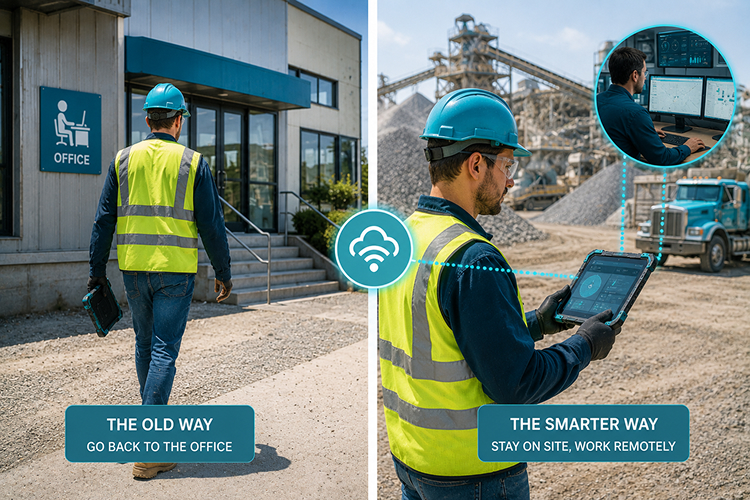
Repairs meant a trip. A tablet that developed a problem usually had to be returned to the office, and for an inspector out in the field that was a lost day, sometimes more. On top of that, management had no way to tell who had actually visited which site. Everything rode on whatever the inspector wrote down by hand in the report.
The Solution: Headwind MDM Across the Fleet
The company decided to put Headwind MDM on every tablet. Four things did most of the work.
Multi-App Kiosk Mode
Headwind MDM cut each tablet down to three apps: the inspection app, WhatsApp, and the dialer. The managed launcher hid other apps, so there was no web browser or app store to install whatever an inspector found online.
The multi-app part mattered. Inspectors needed to move between logging a check, messaging a supervisor, and making a call, so a strict single-app mode would only have gotten in the way. A fixed list of a few apps kept the device under control without making it useless.
Centralized App Updates From Headquarters
IT rolled the inspection app out to all the tablets from headquarters at once. No inspector had to bring a device back for an update, and there were no more stragglers running last quarter’s build. The audit problem went away along with it.
GPS Location Tracking Across the Fleet
Headwind MDM reported each device’s location to management, so supervisors could see which sites were visited and when, instead of relying on what inspectors reported themselves.
Remote Control to Fix Devices Without a Recall
This is where the clearest savings came from. When a tablet started acting up, IT connected to it over the network and worked on it directly. Most of the time it was a setting or an app, not the hardware, so there was nothing to physically fix. The inspector stayed in the field and kept working.
The Results
The numbers management cared about moved in the right direction.
Inspections per week went up about 20%, mostly because inspectors lost less time to downtime and distraction. Around 80% of device problems started getting solved remotely, which took the repair trips out of the picture. All told, the company put the productivity gain at about $15,000 a month, enough to cover the Enterprise license in the first month.
In hours, the math is simple. Before Headwind MDM, a single device failure could take an inspector out for most of a working day, roughly eight hours between the trip and the repair. At one failure per tablet each month across fifty devices, that came to around 400 lost hours a month. Now that 80% of those cases are handled remotely, the company gets back close to 320 of them, on the order of 3,800 hours a year. Add the trimmed data bills and the 20% lift in inspections, and the hours turn into real money fast.
Beyond Cement: Where MDM for Rugged Devices Applies
None of this is specific to cement. Mining, logistics, utilities, warehousing: anyone using rugged devices in hard-to-reach places runs into the same problem, where a broken tablet means a trip on top of the repair.
Headwind MDM runs on-premise or in the cloud, supports Android 9 and up, and works with custom and AOSP builds without depending on Google services. For teams whose devices run outside standard Google Mobile Services, that feature is often what makes the difference.
See pricing and license tiers or start a free cloud trial to test Headwind MDM on your own devices.